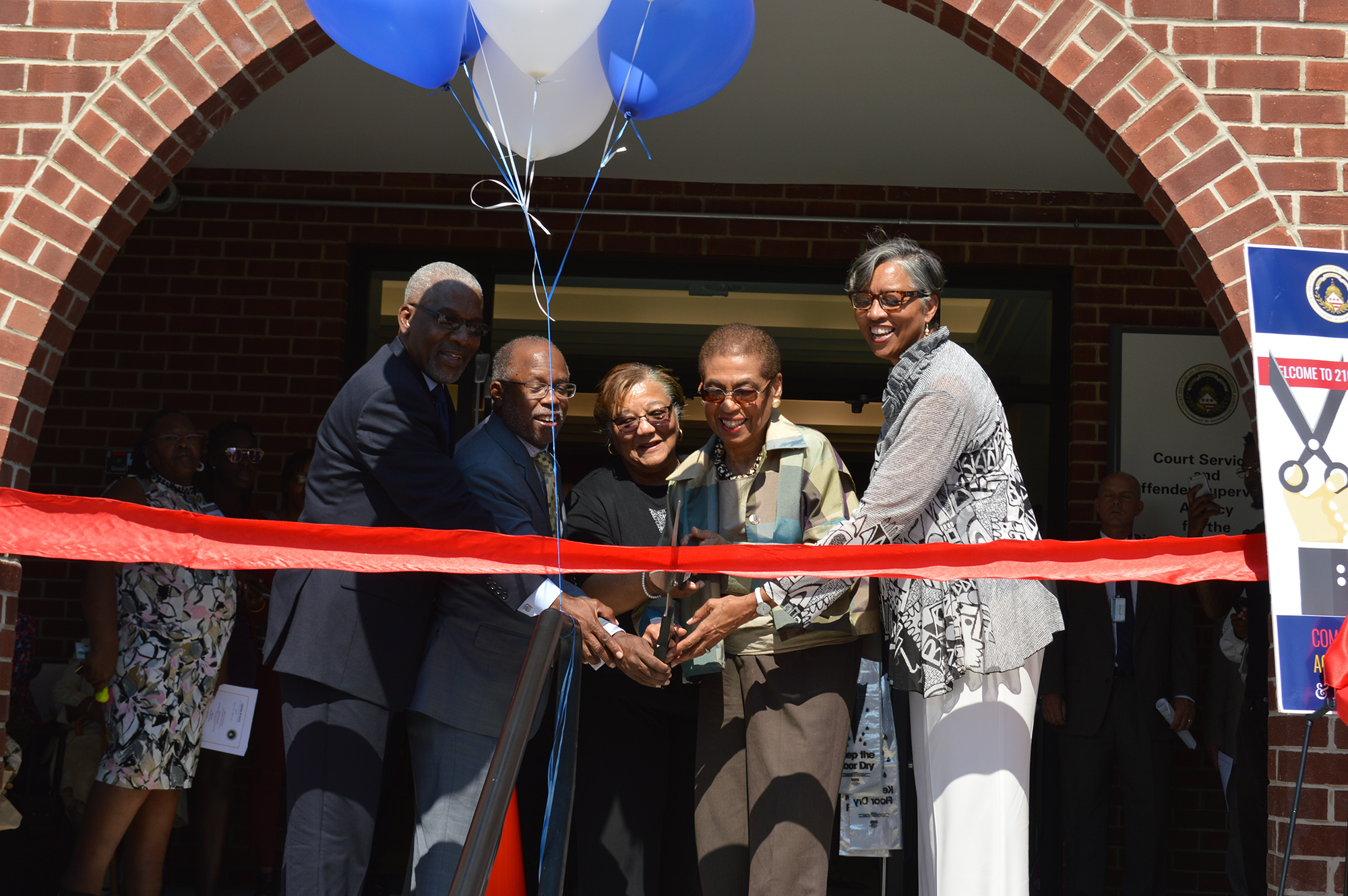
Ribbon cutting at Grand Opening of CSOSA at 2101 Martin Luther King, Jr. Ave SE

Grand Opening of CSOSA at 2101

[vc_row][vc_column][vc_column_text]

On August 1, 2017, we held the Grand Opening of our newest field site at 2101 Martin Luther King Jr. Ave SE. This state-of-the-art facility is located less than half a mile from our old Anacostia field site and a bit closer to the Anacostia Metro Station.

Congresswoman Eleanor Holmes Norton, Councilmember Anita Bonds, Judge Milton Lee, and Reverend Ronald Miles joined Director Nancy Ware, Deputy Director James Berry, and Associate Director Cedric Hendricks in welcoming guests to our new location. After remarks and the ribbon cutting ceremony, guests were invited to tour the facility and learn about the innovative supervision activities that would occur inside.

Community partners, successful justice-involved individuals, and CSOSA staff were stationed around the building to provide greater insight as to how the spaces could be used to further our mission of effective supervision, thereby enhancing public safety in the District of Columbia.

[/vc_column_text][/vc_column][/vc_row][vc_row][vc_column][mk_gallery images=”985,986,987,988,989″ style=”style1″ height=”300″ hover_scenarios=”overlay_layer” overlay_color=”#183d75″ item_spacing=”3″][/vc_column][/vc_row]
Similar Posts

  • |

    CSOSA Celebrates 25 Years

    The Court Services and Offender Supervision Agency Marks Quarter-Century as Independent Federal Agency On August 4, the Court Services and Offender Supervision Agency (CSOSA) recognizes a significant milestone: 25 years as an independent federal executive branch agency serving the District of Columbia. Since its establishment under the National Capital Revitalization and Self-Government Improvement Act of…

  • Welcoming Our New Director

    [vc_row][vc_column][vc_column_text] The Court Services and Offender Supervision Agency for the District of Columbia welcomes Richard S. Tischner as our third presidentially-appointed Director. Mr. Tischner has been a public servant for more than 33 years. He has served as an attorney for the Federal Government of the United States at the Merit Systems Protection Board as…

  • Obstacles to Employment

    [vc_row][vc_column][vc_column_text]In a recent publication from the DC Policy Center, Robin Selwitz explores the myriad obstacles individuals who have been involved in the criminal justice system face when seeking employment. Involvement in the criminal justice system leads to a litany of aftereffects, commonly known as collateral consequences, which can result in unanticipated burdens to those trying…

  • | |

    Community Resource Days and Resource Fairs: Connecting Supervisees to Critical Services

    [vc_row][vc_column][vc_column_text] CSOSA believes strategic partnerships with public and private entities—including local organizations, city government, criminal justice agencies, the faith community, and individual citizens—are critical to facilitating successful reintegration. The agency is committed to ensuring individuals under its supervision have meaningful access to the services that will help them reach their full potential. This access begins…

  • PPPS Week 2018

    Mounting research indicates that there are significant benefits for our communities in helping men and women that have been in prison, jail, or on probation find employment.

    Unfortunately, some employers remain reticent to hiring someone who is or has been involved in the justice system, as evidenced by the need for laws such as Ban the Box, which, among other things, makes it illegal for an employer to inquire about criminal history prior to making a conditional offer of employment. In the District’s highly competitive and saturated job market, gainful employment remains an intractable challenge. For some, it is further compounded by the additional challenges posed by their history of involvement with the justice system.

  • New Supervision Data

    [vc_row][vc_column][vc_column_text]The Court Services and Offender Supervision Agency (CSOSA) relies on data in order to provide evidence-informed and evidence-based supervision to justice-involved individuals in the community. These data are integral to measuring our progress towards our strategic goals. Specifically, working to reduce recidivism by targeting criminogenic risk and needs using innovative and evidence-based strategies; integrating offenders…